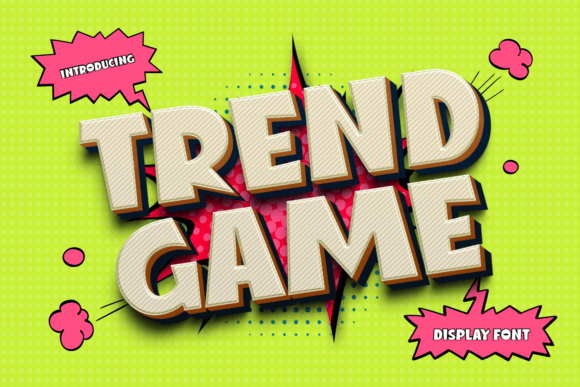
Evaluating Trend Game: A Playful Display Font for Narrative Design
Typography plays a pivotal role in visual storytelling, acting as the bridge between written content and reader engagement. Among the myriad of typefaces available to designers, Trend Game has emerged as a notable option for projects requiring a distinct personality. Defined as a strong display comic font, it combines easy readability with a playful aesthetic. This combination makes it particularly suitable for comic strips, children’s books, and other narrative-driven designs that demand clear yet fun typography. For designers, editors, and content creators evaluating typeface options, understanding the specific characteristics and appropriate applications of Trend Game is essential for making informed design decisions.
Understanding the Characteristics of Trend Game
Trend Game belongs to the category of display fonts, which are designed primarily for use at larger sizes such as headlines, titles, and short bursts of text rather than long body copy. Its classification as a "comic" font indicates that it draws inspiration from the lettering styles found in traditional comic books and graphic novels. These styles typically feature irregular strokes, rounded terminals, and a hand-drawn quality that conveys informality and energy.
The core appeal of Trend Game lies in its balance between whimsy and legibility. Many decorative fonts sacrifice readability for style, resulting in text that is difficult to decipher quickly. However, Trend Game maintains consistent character shapes and adequate spacing, ensuring that the message remains clear even while projecting a lighthearted tone. This dual focus on style and function is what distinguishes it from more chaotic or overly stylized script fonts.
Why Designers Choose Trend Game
When selecting a typeface, designers often look for fonts that align with the emotional tone of their project. Trend Game is frequently chosen for its ability to evoke feelings of joy, nostalgia, and approachability. Here are several reasons why this font may be a strong candidate for specific design needs:
- Enhanced Engagement for Young Audiences: Children respond positively to visuals that feel friendly and accessible. The rounded, soft edges of Trend Game create a welcoming atmosphere, making it an excellent choice for educational materials, storybooks, and packaging aimed at younger demographics.
- Narrative Clarity: In comic strips and graphic novels, dialogue must be read quickly to maintain the flow of the story. Trend Game’s clear structure ensures that speech bubbles and captions are easily readable, preventing visual fatigue for the reader.
- Versatility in Informal Contexts: Beyond children’s media, the font works well in any context that benefits from a casual, human touch. This includes party invitations, hobbyist blogs, craft product labels, and social media graphics where a corporate or sterile aesthetic would feel out of place.
Ideal Use Cases for Trend Game
To maximize the effectiveness of Trend Game, it is important to deploy it in environments where its strengths are most relevant. The font shines in situations where the primary goal is to entertain, educate, or inform in a relaxed manner.
Comic Strips and Graphic Novels
As a comic-style font, Trend Game is naturally suited for sequential art. It can serve effectively as lettering for dialogue, sound effects, or narration boxes. Its consistent weight helps maintain visual harmony across panels, while its playful nature supports the humorous or adventurous tones common in the genre.
Children’s Literature and Educational Materials
For picture books and early readers, typography must support literacy development without appearing intimidating. Trend Game’s distinct letterforms help children recognize characters easily, while its fun appearance keeps them engaged. It is also suitable for worksheets, classroom posters, and learning apps that aim to make education enjoyable.
Branding for Lifestyle and Hobby Brands
Businesses in the creative, craft, or entertainment sectors often seek branding that feels authentic and handmade. Trend Game can be used in logos, taglines, or promotional materials for businesses such as toy stores, indie game developers, or artisanal bakeries. It helps communicate a brand personality that is approachable and community-oriented.
Limitations and Considerations
While Trend Game offers significant benefits for specific applications, it is not a universal solution. Understanding its limitations is crucial for avoiding design missteps. As a display font, it is not intended for extended blocks of text. Using Trend Game for long paragraphs, legal disclaimers, or dense informational content can lead to reader fatigue due to its irregular stroke widths and decorative elements.
Additionally, the playful nature of the font may clash with serious or formal subjects. It would generally be inappropriate for financial reports, medical documentation, corporate law firms, or high-end luxury branding where elegance and minimalism are preferred. In these contexts, the informality of Trend Game could undermine the perceived credibility or sophistication of the content.
Another consideration is pairing. Because Trend Game has a strong personality, it requires careful selection of complementary fonts. Pairing it with another decorative or handwritten font can create visual clutter. Instead, it is often best paired with clean, neutral sans-serif or serif fonts for body text. This contrast allows Trend Game to stand out as a headline element while ensuring the supporting text remains unobtrusive and easy to read.
Comparing Alternatives
When evaluating Trend Game, it is helpful to consider how it compares to other options in the comic and display font categories. Some alternatives may offer a more rugged or distressed look, suitable for action-oriented themes, while others may be more refined and elegant. If a project requires a stricter adherence to traditional comic book aesthetics, designers might explore fonts that mimic specific ink-brush techniques. Conversely, if the goal is modern minimalism with a hint of playfulness, a geometric sans-serif with rounded corners might be a more subtle alternative.
The decision ultimately depends on the specific nuance required. Trend Game sits comfortably in the middle ground, offering enough character to be distinctive without being so eccentric that it becomes distracting. It is a safe yet effective choice for designers who want a comic-inspired look without venturing into overly niche or extreme stylistic territories.
Making the Right Choice for Your Project
Selecting the right typography involves balancing aesthetic goals with functional requirements. To determine if Trend Game aligns with your needs, consider the following questions:
- Who is the target audience? If the audience includes children or individuals seeking lighthearted entertainment, Trend Game is likely a strong fit. For professional or academic audiences, it may be less appropriate.
- What is the volume of text? If the text is limited to headlines, titles, or short captions, Trend Game will perform well. For long-form content, reserve it for headings only and choose a more neutral font for the body.
- What is the brand voice? Does the brand value fun, accessibility, and creativity? If so, the playful style of Trend Game supports these values. If the brand emphasizes precision, authority, or luxury, other typefaces may better convey those attributes.
In conclusion, Trend Game is a versatile and engaging display font that excels in narrative-driven and youth-oriented designs. Its strength lies in its ability to combine readability with a cheerful, comic-inspired aesthetic. By understanding its ideal use cases and recognizing its limitations, designers can leverage Trend Game to enhance visual communication effectively. Whether used in a children’s book, a comic strip, or a casual branding project, it offers a reliable way to inject personality and clarity into visual content. As with any design tool, its success depends on thoughtful application and harmonious integration with other design elements.