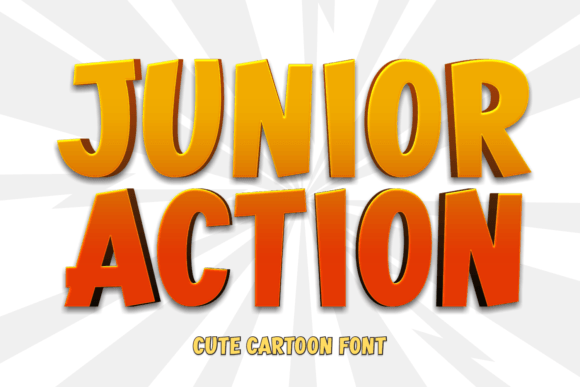
Junior Action: Strategic Typography for Playful Brand Positioning
In the crowded landscape of visual communication, typography is rarely just about legibility; it is a primary vehicle for tone, personality, and brand positioning. Junior Action, a cute cartoon font, has emerged as a versatile tool that transcends its initial categorization as merely "child-friendly." While its whimsical curves and informal structure naturally appeal to younger demographics, strategic designers and marketers are increasingly leveraging Junior Action to humanize brands, soften corporate messaging, and create distinctive visual identities in adult-oriented markets. Understanding when and how to deploy this typeface requires a shift from aesthetic preference to strategic intent.
Beyond the Playground: Expanding the Utility of Junior Action
The immediate association with cartoon fonts is often limited to children’s books, educational materials, or toy packaging. However, limiting Junior Action to these contexts ignores its potential in broader commercial applications. In an era where consumers crave authenticity and approachability, brands are moving away from sterile, hyper-corporate aesthetics. A font like Junior Action offers a calculated departure from rigidity. It signals creativity, openness, and a lack of pretension.
For entrepreneurs and small business owners, the choice of typography is a low-cost, high-impact decision. Using Junior Action in branding materials can differentiate a product in a saturated market. Consider a craft coffee shop aiming to appear community-focused rather than elitist, or a tech startup specializing in user-friendly productivity tools for non-technical users. In these scenarios, the playful nature of the font reduces psychological barriers, making the brand feel more accessible and less intimidating. The key is not to use the font because it is "cute," but because it aligns with a strategic goal of approachability and warmth.
Strategic Applications in Branding and Packaging
When integrating Junior Action into product packaging, the objective is often to evoke nostalgia or joy. Adult consumers frequently respond positively to design elements that trigger positive emotional memories. A skincare line focusing on self-care and relaxation might use this font for limited-edition summer releases to convey lightness and fun, contrasting with their usual minimalist, serious branding. This tactical shift keeps the brand dynamic and engaging without compromising its core identity.
Similarly, in social media graphics, where attention spans are short and competition is fierce, Junior Action can serve as a visual hook. Its distinct letterforms stand out against the backdrop of standard sans-serif headlines that dominate feeds. For creators and influencers, using this font in quote cards, event announcements, or promotional banners can increase engagement by breaking visual monotony. However, consistency is crucial. Randomly switching fonts dilutes brand recognition. Therefore, Junior Action should be adopted as part of a defined visual system, used specifically for headlines or call-to-action elements while maintaining neutral body text for readability.
Enhancing Customer Experience Through Tone
Communication extends beyond visuals into the textual experience. While Junior Action is a display font and not suitable for long-form body copy, its influence can guide the tone of voice in micro-copy. When a brand chooses a playful typeface for its interface or packaging, it sets an expectation for the language used. Support messages, error pages, or onboarding instructions can adopt a lighter, more conversational tone to match the visual cue. This alignment between visual design and verbal communication creates a cohesive customer experience that feels thoughtful and intentional.
Educators and trainers also find value in this approach. Adult learning environments often suffer from dry, academic presentations. Incorporating Junior Action in slide decks for workshops on creativity, team building, or innovation can subtly signal that the session will be interactive and low-stress. It helps lower anxiety and encourages participation, demonstrating how typography can influence behavioral outcomes in professional settings.
Risks and Considerations: When Not to Use Junior Action
Despite its versatility, Junior Action is not a universal solution. Misapplication can lead to perceptions of unprofessionalism or lack of seriousness. Industries that rely heavily on trust, security, and precision—such as finance, law, or healthcare—should exercise extreme caution. Using a cartoon font in these contexts may undermine credibility and suggest a lack of rigor. The decision to use Junior Action must be weighed against the brand’s core values and the expectations of its target audience.
Another risk is visual fatigue. Because the font is highly stylized, overuse can become distracting. It lacks the neutrality required for complex information hierarchy. Designers must ensure that Junior Action is paired with clean, highly legible secondary fonts. A common mistake is using it for subheadings or captions where clarity is paramount. Strategic restraint ensures that the font retains its impact as a highlight rather than becoming background noise.
- Avoid using Junior Action for legal disclaimers, technical specifications, or dense data tables.
- Limit usage to headlines, logos, short quotes, or decorative elements.
- Test legibility across different sizes and mediums, particularly on mobile devices where screen real estate is limited.
- Ensure color contrast is sufficient, as playful fonts can sometimes lose definition if paired with low-contrast backgrounds.
Planning for Long-Term Brand Equity
Adopting Junior Action should be viewed as a long-term branding decision rather than a fleeting trend. Trends in typography cycle rapidly, but a well-chosen display font can become synonymous with a brand’s identity if used consistently. To achieve this, businesses should document guidelines for its use. Define specific scenarios where the font is appropriate and where it is prohibited. This operational discipline prevents ad-hoc design decisions that could fragment the brand image.
Furthermore, consider the scalability of the font. As a business grows, its communication channels expand. Will Junior Action work on large-scale outdoor advertising? Will it remain effective in email newsletters? Testing the font across various touchpoints during the planning phase ensures that it remains a viable asset as the organization evolves. This foresight protects the investment in brand development and ensures consistent customer recognition.
Decision-Making Framework for Designers
Before selecting Junior Action for a project, ask three critical questions:
- What is the primary emotion we want to evoke? If the answer is joy, nostalgia, or approachability, the font is a strong candidate. If the goal is authority or luxury, look elsewhere.
- Who is the audience? Even within adult demographics, preferences vary. A creative agency’s clients may appreciate the whimsy, while a B2B software buyer may prefer clarity and minimalism.
- Does it support the message? The font should enhance the content, not compete with it. If the message is complex, the font should recede. If the message is simple and emotional, Junior Action can amplify it.
By approaching typography with this level of strategic scrutiny, designers and marketers transform Junior Action from a simple aesthetic choice into a powerful tool for communication. It becomes a deliberate element of a broader strategy to connect with audiences on a human level, fostering loyalty and engagement through thoughtful design.
Conclusion: Intentionality Drives Results
The effectiveness of Junior Action lies not in its inherent cuteness, but in the intentionality behind its use. For professionals seeking to inject personality into their brands, this font offers a unique blend of charm and versatility. However, success depends on understanding its limitations and pairing it with disciplined design practices. By focusing on goals, audience needs, and consistent application, you can leverage Junior Action to create memorable, impactful designs that resonate with adults and children alike. The result is not just a visually appealing project, but a strategically sound communication asset that supports long-term business objectives.